
Every few months, the same thing happens. Results come out, headlines announce that profit “jumped” or “missed estimates,” and stocks swing. If you hold, or are thinking about buying, the Tata Capital share price or the Bajaj Finance share, you will see this cycle up close.
Most investors react to the headline. Few open the actual report. That is a shame, because the real story for a lender sits a few pages deeper. This guide shows you where to look, what the numbers mean, and how to avoid being fooled by one good quarter.
Why results matter more for lenders
For a manufacturing company, profit mostly reflects sales and costs. For a lender, there is an extra layer: the quality of what it has already lent. A bank or NBFC can report excellent profit today and still be sitting on loans that will go bad next year.
That is why reading a lender’s results means checking three things together: how fast it is growing, how much it earns on that growth, and how safe the loans are.
A quick note on the two companies
Tata Capital is the flagship financial services company of the Tata Group and a subsidiary of Tata Sons. It lends across home loans, car loans, business loans, and other products, and it began trading on the stock exchanges on 13 October 2025 at ₹330. Because it is a recent listing, you will have fewer quarters of public results to compare.
Bajaj Finance belongs to the Bajaj Finserv group and is well known for consumer finance, small business loans, and a broad range of retail products. It has been listed for many years, so you can compare a long run of quarters and see how it handled both strong and difficult periods.
Step 1: Look at the loan book (assets under management)
Start with the size of the business. Assets under management, often shortened to AUM, shows the total amount the company has lent out and manages.
Two questions help here:
- Is AUM growing steadily compared with the same quarter last year?
- Is growth coming from a healthy mix of products, or from one risky area?
Compare with the same quarter a year earlier instead of the previous quarter, because lending demand has seasonal patterns, such as festive-season spikes.
Step 2: Check net interest income and margin
Net interest income is the difference between the interest the company earns on loans and the interest it pays to fund them. Net interest margin, or NIM, expresses that spread as a percentage of its earning assets.
A rising margin usually means the company is pricing loans well or funding itself cheaply. A shrinking margin can signal rising funding costs, tougher competition, or pressure on loan pricing. Pay attention to the direction over several quarters, since a single reading can be noisy.
Step 3: Read the asset quality section carefully
This is the most important section for any lender. Look for:
- Gross NPA: the share of total loans that borrowers have stopped repaying.
- Net NPA: the same figure after setting aside money to cover expected losses.
- Provision coverage: how much of the bad loans the company has already provided for.
Lower NPA numbers are better, but the trend matters as much as the level. A slowly improving figure is more comforting than one that has suddenly jumped. Also check the mix between secured loans, such as those backed by property or vehicles, and unsecured ones. Unsecured lending can grow faster, but it usually carries more risk when conditions weaken.
Step 4: Look at credit costs
Credit cost is the money the company sets aside, or writes off, because of loans that might not be repaid. If profit rose only because the company provided less for bad loans, the improvement may not last.
A good habit is to ask: would profit still look strong if credit costs returned to their usual level? If the answer is unclear, treat the headline growth with caution.
Step 5: Judge profitability and capital
Finally, check how efficiently the company turns money into profit.
- Return on equity (ROE): profit earned on shareholder funds.
- Return on assets (ROA): profit earned on the whole balance sheet.
- Capital adequacy: whether the company holds enough capital to keep lending and absorb shocks.
High returns are attractive, but they should come with a comfortable capital buffer. A lender that grows rapidly while thinning out its buffer is taking on more risk, even if profits look wonderful.
What to ignore, or at least question
One-off items. A large one-time gain can lift profit for a quarter without saying anything about the underlying business. Look for what the company itself calls exceptional.
Single-quarter reactions. The price may move sharply on the day. That reflects the market’s first reaction, not necessarily the right long-term judgement.
Comparing share prices. A higher price per share does not mean a bigger or better company. Compare valuation ratios and quality of earnings instead.
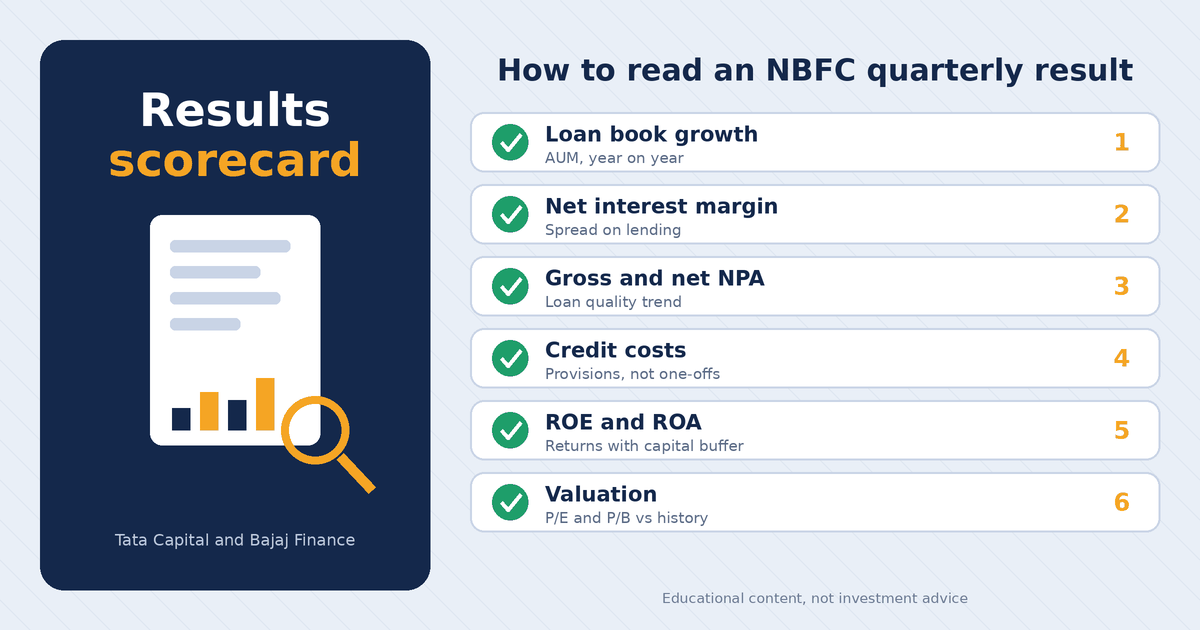
Putting it together: a one-page scorecard
When results arrive, jot down answers to these questions for each company:
| Question | What you want to see |
|---|---|
| Is AUM growing year on year? | Steady, not erratic |
| Is net interest margin stable or rising? | Stable or improving |
| Are gross and net NPA falling or flat? | Flat or falling |
| Are credit costs reasonable? | Not unusually low or spiking |
| Are ROE and ROA healthy? | Healthy, with a solid capital buffer |
| Is the valuation reasonable for this quality? | Not stretched compared with history and peers |
If most boxes are ticked, the quarter was solid. If several are not, dig deeper before deciding.
The timing question
Many people ask whether they should buy before results or wait. There is no reliable answer, because markets often move on expectations rather than on the numbers themselves. A good result that merely meets high expectations can still see the price fall, and a weak result that is better than feared can see it rise.
A calmer approach is to decide your plan in advance. Know what you are looking for, set the amount you are comfortable investing, and avoid making big decisions in the first few minutes after a headline appears.
A reminder about diversification
Both companies are lenders, and lending stocks often move together when interest rates or regulations change. If your portfolio already holds several banks and financial companies, owning both of these may not spread your risk as much as you expect. Check your overall mix before adding more.
Final thoughts
Quarterly results are not a test you need to predict. They are a report card you can learn to read. Once you know where to look at growth, margins, loan quality, and capital, the Tata Capital share price and the Bajaj Finance share stop feeling like random numbers and start reflecting businesses you can evaluate.
Read the full report, compare it with earlier quarters, and make your decision from the numbers rather than the noise.
Disclaimer: This article is for educational purposes only and is not investment advice. Investments in the securities market are subject to market risks. Please read all related documents carefully and consult a SEBI-registered advisor before investing.